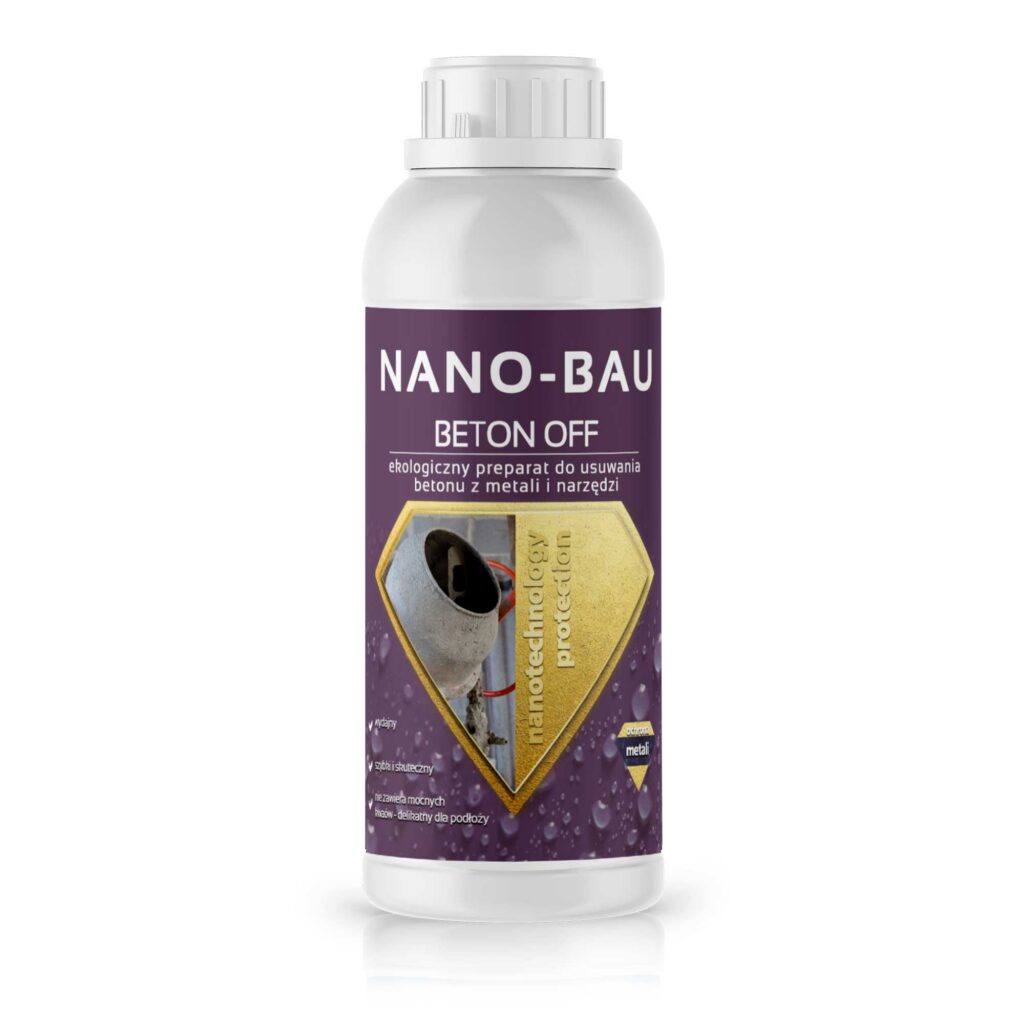
BETON OFFRemoval of concrete and mortar residues
BETON OFF by NANO-BAU: NANO-BAU Beton off is a concrete remover. It helps remove concrete and cement residues from tools, moulds and construction equipment. Contact time depends on the thickness and age of the deposit.
BETON OFF by NANO-BAU: NANO-BAU Beton off is a concrete remover. It helps remove concrete and cement residues from tools, moulds and construction equipment. Contact time depends on the thickness and age of the deposit.
BETON OFF — Properties and performance
- Helps remove concrete and cement residues from tools, moulds and construction equipment.
- Cleaning can be carried out separately from subsequent surface protection.
- Defined preparation and trial procedures help assess the result.
Removal of concrete and mortar residues
Substrates
- tools and equipment compatible with the label
- moulds, formwork and construction equipment following a compatibility trial
- removal of mortar residues
- cleaning equipment after concreting
BETON OFF — Technical parameters
Establish consumption by trial; no single confirmed m²/l rate covers deposits of different thicknesses.
The stated contact time is 15 minutes–12 hours, depending on the deposit. Extended contact requires label compliance and a resistant substrate. Wear gloves and goggles.
Technical documentation
Data from the product description and technical documentation. Follow the current label for the supplied variant and confirm working conditions by a substrate trial.
Surface preparation
First test a small, inconspicuous area.
- Remove loose dirt, protect adjacent elements and select preparation and pre-wetting methods according to this product’s instructions.
- Carry out a compatibility trial and assess the complete result before treating a larger area.
BETON OFF — Application method
- Use concentrate, or dilute 1:5 for light deposits; apply at low pressure, monitor the action and rinse thoroughly.
- The stated contact time is 15 minutes–12 hours, depending on the deposit. Extended contact requires label compliance and a resistant substrate. Wear gloves and goggles.
- After treatment, check the uniformity of the result and follow the conditions for subsequent use stated on the label.
Conditions and drying time
The stated contact time is 15 minutes–12 hours, depending on the deposit. Extended contact requires label compliance and a resistant substrate. Wear gloves and goggles.
Consumption, packs and calculations
Establish consumption by trial; no single confirmed m²/l rate covers deposits of different thicknesses.
Confirm consumption on a representative trial area; do not assume rates from similar products.
| Pack sizes | Indicative pack coverage |
|---|---|
| 500 ml | Establish by trial and from the label |
| 1 L | Establish by trial and from the label |
| 5 L | Establish by trial and from the label |
| 10 L | Establish by trial and from the label |
| 20 L | Establish by trial and from the label |
| 200 L | Establish by trial and from the label |
| 1000 L | Establish by trial and from the label |
Example for 50 m²
No universal conversion applies. Establish the quantity for the particular process and substrate.
Maintenance and limitations
The effect is removal of the existing deposit. The product is not a protective coating lasting several years.
- First test compatibility in an inconspicuous area. Cleaning does not create a durable protective impregnation.
Storage and safety
- Store in tightly closed, labelled original packaging, inaccessible to children. Observe the label’s storage conditions and shelf life. Do not transfer to food containers. Do not discharge product residues into water, soil or drains; follow the safety data sheet.
Read the current label and safety data sheet before use. Wear the required personal protective equipment. Do not mix with other products.
H315, H319
Product questions
Which surfaces is this product intended for?
- tools and equipment compatible with the label
- moulds, formwork and construction equipment following a compatibility trial
What consumption should I use?
Establish consumption by trial; no single confirmed m²/l rate covers deposits of different thicknesses.
Confirm consumption on a representative trial area; do not assume rates from similar products.
How should the substrate be prepared?
- Remove loose dirt, protect adjacent elements and select preparation and pre-wetting methods according to this product’s instructions.
- Carry out a compatibility trial and assess the complete result before treating a larger area.
How is the product applied?
- Use concentrate, or dilute 1:5 for light deposits; apply at low pressure, monitor the action and rinse thoroughly.
- The stated contact time is 15 minutes–12 hours, depending on the deposit. Extended contact requires label compliance and a resistant substrate. Wear gloves and goggles.
- After treatment, check the uniformity of the result and follow the conditions for subsequent use stated on the label.
What conditions are needed for drying?
The stated contact time is 15 minutes–12 hours, depending on the deposit. Extended contact requires label compliance and a resistant substrate. Wear gloves and goggles.
How should durability and renewal be assessed?
The effect is removal of the existing deposit. The product is not a protective coating lasting several years.
What are the limitations of use?
- First test compatibility in an inconspicuous area. Cleaning does not create a durable protective impregnation.
How should the product be stored?
- Store in tightly closed, labelled original packaging, inaccessible to children. Observe the label’s storage conditions and shelf life. Do not transfer to food containers. Do not discharge product residues into water, soil or drains; follow the safety data sheet.
Planning your project with BETON OFF
Start by identifying the material, its finish and the result you want to achieve. The product information above sets out the intended use of BETON OFF. Check these details against your own surface before deciding on the treatment. A product intended for one material should not be assumed suitable for a different substrate simply because the two look similar.
Measure the area and inspect its condition before ordering. Existing coatings, dirt, uneven absorbency and previous treatments can affect preparation and application. Use a small, representative trial area to check compatibility, appearance and actual consumption. For a large project, compare several locations rather than relying on a single unusually smooth or sheltered patch.
Keep a record of the quantity used during the trial and the area treated. Where a consumption range is provided, use it as a planning guide and confirm it under the actual site conditions. Follow the stated application sequence; do not multiply a complete-treatment consumption figure by the number of coats unless the instructions explicitly require it.
Before applying BETON OFF, read the current product label and the linked technical documentation. Keep adjacent materials protected and arrange the work around the required weather and drying conditions. Inspect the result after the specified curing or drying period and plan routine maintenance according to the product’s limitations.
Explore the NANO-BAU product catalogue to compare applications, or contact NANOBIZ.PL for help identifying the appropriate product. This page describes BETON OFF; it does not replace the instructions supplied with your particular pack.