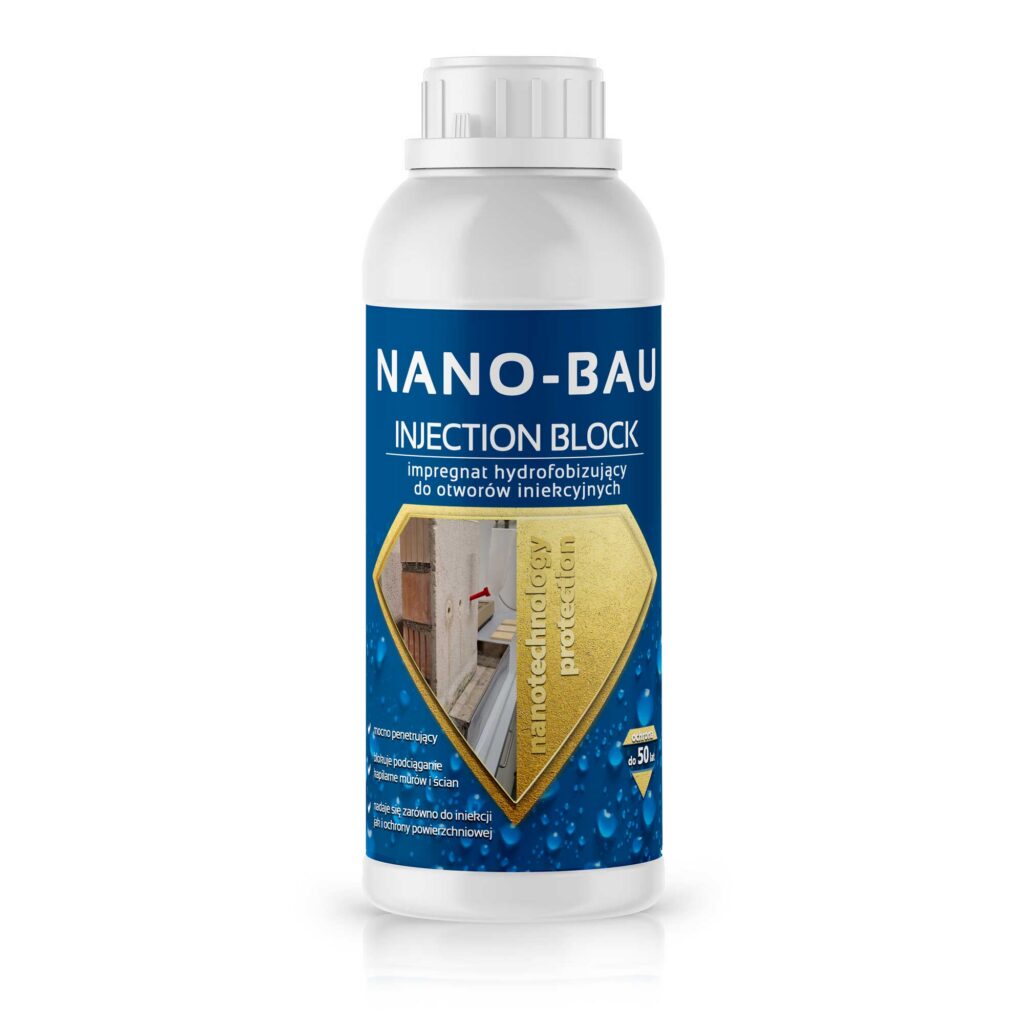
INJECTION BLOCKA barrier to limit capillary rising damp
INJECTION BLOCK by NANO-BAU: NANO-BAU INJECTION BLOCK is a hydrophobic silane-based product for forming a barrier that limits capillary rising damp. It is intended for suitably assessed brick, concrete and stone walls. Gravity or pressure injection, hole specifications and dosage must be determined for the particular structure.
INJECTION BLOCK — Product overview
INJECTION BLOCK by NANO-BAU: NANO-BAU INJECTION BLOCK is a hydrophobic silane-based product for forming a barrier that limits capillary rising damp. It is intended for suitably assessed brick, concrete and stone walls. Gravity or pressure injection, hole specifications and dosage must be determined for the particular structure.
INJECTION BLOCK — Properties and performance
- A barrier to limit capillary rising damp
A barrier to limit capillary rising damp
Substrates
- Suitably assessed brick, concrete and stone walls
INJECTION BLOCK — Technical parameters
Dosage in l/linear m is established for the wall and method; there is no universal conversion to m².
Gravity or pressure application according to the work specification; provide ventilation and exclude ignition sources.
Technical documentation
PDF in Polish · INJECTION BLOCK ↗
Data from the product description and technical documentation. Follow the current label for the supplied variant and confirm working conditions by a substrate trial.
Surface preparation
First test a small, inconspicuous area.
- Identify the damp and examine the material, joints, thickness and voids. Locate services.
- Select the method, hole specifications and number of rows from the work specification, checking the product’s indicative recommendations.
INJECTION BLOCK — Application method
- Confirm dosage and prepare the wall and holes according to the selected method.
- Introduce the specified quantity by gravity or a suitable pressure system. Monitor uptake.
- Allow moisture to evaporate. Assess the wall and salt contamination before further renovation.
- Gravity application uses a suitable funnel; pressure application requires an appropriate system. Selection depends on wall condition and the work specification. The technical sheet refers to pressure application particularly for highly damp substrates; equipment settings are determined by the contractor.
- The technical sheet gives indicative spacing of approximately 12–15 cm, an angle of approximately 15–30° and a depth of approximately 80% of wall thickness. A staggered arrangement mentions approximately 10 cm between axes. Verify these values for the structure, number of rows and barrier alignment; they are not a universal design.
Conditions and drying time
Gravity or pressure application according to the work specification; provide ventilation and exclude ignition sources.
Consumption, packs and calculations
Dosage in l/linear m is established for the wall and method; there is no universal conversion to m².
Quantity follows wall length and the dosage established for the structure. Do not convert wall surface area into a universal litre requirement.
| Pack sizes | Indicative pack coverage |
|---|---|
| 1 L | Establish by trial and from the label |
| 5 L | Establish by trial and from the label |
| 10 L | Establish by trial and from the label |
| 20 L | Establish by trial and from the label |
| 200 L | Establish by trial and from the label |
No universal conversion applies. Establish the quantity for the particular process and substrate.
Maintenance and limitations
No single numerical service life is stated for all applications. Assess surface condition and retreatment needs according to use.
- The work plan should follow diagnosis of the moisture source and wall construction. Wall thickness, material, joints, voids and moisture levels affect distribution of the product. A hydrophobic zone requires the product to reach the material correctly.
- Do not transfer a solid-brick wall method to heterogeneous masonry without assessment. Voids can change liquid flow and require specific preparation. Locate services before drilling.
- Injection limits capillary moisture supply, while moisture already in the wall must evaporate gradually. Plan renovation around drying conditions, salts and other sources of damp.
- Record injection points, actual consumption, uptake difficulties and measurements. Assess compatibility of the proposed system before painting or rendering. Treat surface application of BLOCK separately, following its instructions and appropriate units.
Storage and safety
- Store in tightly closed, labelled original packaging, inaccessible to children. Observe the label’s storage conditions and shelf life. Do not transfer to food containers. Do not discharge product residues into water, soil or drains; follow the safety data sheet. Store locked away in a cool, well-ventilated place, away from ignition sources and hot surfaces.
Read the current label and safety data sheet before use. Wear the required personal protective equipment. Do not mix with other products.
H225, H319, H336
INJECTION BLOCK — Product questions
Which surfaces is this product intended for?
- Suitably assessed brick, concrete and stone walls
What consumption should I use?
Dosage in l/linear m is established for the wall and method; there is no universal conversion to m².
Quantity follows wall length and the dosage established for the structure. Do not convert wall surface area into a universal litre requirement.
How should the substrate be prepared?
- Identify the damp and examine the material, joints, thickness and voids. Locate services.
- Select the method, hole specifications and number of rows from the work specification, checking the product’s indicative recommendations.
How is the product applied?
- Confirm dosage and prepare the wall and holes according to the selected method.
- Introduce the specified quantity by gravity or a suitable pressure system. Monitor uptake.
- Allow moisture to evaporate. Assess the wall and salt contamination before further renovation.
- Gravity application uses a suitable funnel; pressure application requires an appropriate system. Selection depends on wall condition and the work specification. The technical sheet refers to pressure application particularly for highly damp substrates; equipment settings are determined by the contractor.
- The technical sheet gives indicative spacing of approximately 12–15 cm, an angle of approximately 15–30° and a depth of approximately 80% of wall thickness. A staggered arrangement mentions approximately 10 cm between axes. Verify these values for the structure, number of rows and barrier alignment; they are not a universal design.
What conditions are needed for drying?
Gravity or pressure application according to the work specification; provide ventilation and exclude ignition sources.
How should durability and renewal be assessed?
No single numerical service life is stated for all applications. Assess surface condition and retreatment needs according to use.
What are the limitations of use?
- The work plan should follow diagnosis of the moisture source and wall construction. Wall thickness, material, joints, voids and moisture levels affect distribution of the product. A hydrophobic zone requires the product to reach the material correctly.
- Do not transfer a solid-brick wall method to heterogeneous masonry without assessment. Voids can change liquid flow and require specific preparation. Locate services before drilling.
- Injection limits capillary moisture supply, while moisture already in the wall must evaporate gradually. Plan renovation around drying conditions, salts and other sources of damp.
- Record injection points, actual consumption, uptake difficulties and measurements. Assess compatibility of the proposed system before painting or rendering. Treat surface application of BLOCK separately, following its instructions and appropriate units.
How should the product be stored?
- Store in tightly closed, labelled original packaging, inaccessible to children. Observe the label’s storage conditions and shelf life. Do not transfer to food containers. Do not discharge product residues into water, soil or drains; follow the safety data sheet. Store locked away in a cool, well-ventilated place, away from ignition sources and hot surfaces.
Planning your project with INJECTION BLOCK
Start by identifying the material, its finish and the result you want to achieve. The product information above sets out the intended use of INJECTION BLOCK. Check these details against your own surface before deciding on the treatment. A product intended for one material should not be assumed suitable for a different substrate simply because the two look similar.
Measure the area and inspect its condition before ordering. Existing coatings, dirt, uneven absorbency and previous treatments can affect preparation and application. Use a small, representative trial area to check compatibility, appearance and actual consumption. For a large project, compare several locations rather than relying on a single unusually smooth or sheltered patch.
Keep a record of the quantity used during the trial and the area treated. Where a consumption range is provided, use it as a planning guide and confirm it under the actual site conditions. Follow the stated application sequence; do not multiply a complete-treatment consumption figure by the number of coats unless the instructions explicitly require it.
Before applying INJECTION BLOCK, read the current product label and the linked technical documentation. Keep adjacent materials protected and arrange the work around the required weather and drying conditions. Inspect the result after the specified curing or drying period and plan routine maintenance according to the product’s limitations.
Explore the NANO-BAU product catalogue to compare applications, or contact NANOBIZ.PL for help identifying the appropriate product. This page describes INJECTION BLOCK; it does not replace the instructions supplied with your particular pack.